
Standard, off-the-shelf epoxy resins power the vast majority of industrial, aerospace, and electronics applications. Manufactured to high specifications, catalog materials provide reliable, cost-effective performance across established manufacturing workflows.
However, advanced projects occasionally introduce precise operational requirements, unique substrate combinations, or strict regulatory standards that fall outside the parameters of standard formulations. In these specific scenarios—where a project requires a exact cure profile, modified viscosity for specialized equipment, or compliance with precise outgassing thresholds—custom polymer formulation serves as an essential engineering tool.
Tailoring Chemistry to Exact Application Standards
Custom formulation builds upon proven polymer chemistry to align resin properties with specialized project requirements. Rather than replacing standard materials, custom engineering modifies specific physical, thermal, or mechanical attributes to meet exact technical specifications.
By adjusting chemical structures, filler loadings, and curing mechanisms, formulation specialists adapt materials to address targeted parameters:
- Viscosity & Rheology Modification: Fine-tuning fluid dynamics to match automated dispensing equipment, improve flow into intricate geometries, or add thixotropism for vertical bondlines.
- Cure Profile Optimization: Modifying working life (pot life), gel times, and cure temperatures to integrate seamlessly into existing production schedules or protect heat-sensitive components.
- Thermal & Environmental Compliance: Enhancing glass transition temperature (Tg), lowering coefficient of thermal expansion (CTE), or engineering formulations to meet NASA outgassing requirements (ASTM E595).
- Targeted Physical Properties: Modifying density for weight-critical applications, adjusting flexibility for thermal cycling, or adding custom color indicators for visual inspection.
Engineering Application: Satellite Panel Edge Filling
Consider a scenario in satellite manufacturing that illustrates how custom formulation addresses specific technical needs. A satellite OEM required an epoxy formulation specifically for honeycomb panel edge filling that needed to meet precise weight, flow, and thermal stability criteria.
The project called for a combination of performance traits:
- Low density to maintain strict payload weight limits.
- Low viscosity to ensure complete, void-free flow into honeycomb structures.
- High thermal stability to withstand spaceflight environments.

To satisfy all three requirements in a single system, the engineering team developed RF 1164 A/B, a low-density syntactic epoxy system. The specialized material optimized flow characteristics for efficient application while maintaining the high-temperature performance necessary for satellite operations—demonstrating how tailored chemistries solve specific design criteria. Read the case study →
Accelerating Qualification with In-House Testing
When specialized specifications must be met, verifying material performance quickly is critical to maintaining project schedules.
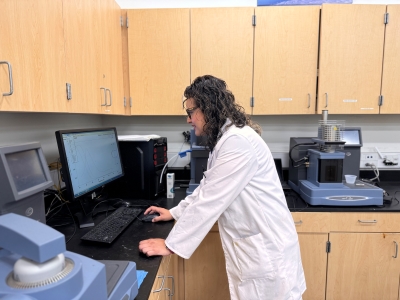
Integrating advanced polymer characterization directly into the formulation process streamlines verification. Operating within an ISO 9001:2015, AS9100 Rev. D, and AS9120 Rev. B certified laboratory, on-site chemists and testing technicians evaluate batch samples directly against customer specifications, cutting traditional material development and testing timelines by up to 50%.
Key testing capabilities that support custom formulation qualification include:
- Thermal Analysis (DSC & DMA): Confirming Tg, degree of cure, and thermal stability across operational temperature windows.
- Mechanical Validation: Evaluating tensile, compression, and lap shear strength under sub-ambient and elevated conditions.
- Rheological Mapping: Testing viscosity profiles, gel times, and exothermic properties to match production line equipment.
Precision Packaging from Bench to Production Line
Achieving consistent results in production requires both precise chemistry and controlled application. Tailoring material delivery through specialty packaging—such as pre-mixed and frozen (PM&F) syringes, dual-barrel cartridges, or pre-measured kits—ensures exact mix ratios, simplifies handling, and eliminates material waste on the shop floor.
Whether matching a unique processing profile, meeting strict aerospace standards, or fine-tuning material performance for complex assemblies, custom formulation offers a reliable path to meeting exact engineering specifications.
Partner with the Resin Formulators Technical Team
Accessing custom formulation expertise is simple and direct. Engineering teams and technical buyers can initiate a project consultation by submitting a quick inquiry through the Resin Formulators online contact form.
Whether requesting input from resident chemists on feasibility, submitting target technical specs, or exploring tailored packaging formats, filling out the contact form connects you directly with the technical team to start engineering your custom solution.
Frequently Asked Questions
When should an engineering team consider a custom epoxy formulation over a standard catalog resin?
Custom formulations are ideal when application requirements fall outside standard catalog parameters—such as needing a specific viscosity for automated dispensing, unique thermal cycling tolerances, specific density targets, or compliance with specialized industry standards.
How does custom formulation impact project development timelines?
In-house advanced material testing and polymer characterization allow formulation iterations and specification testing to occur in parallel, reducing traditional material qualification timelines by up to 50%.
Can custom formulations be certified to aerospace and defense quality standards?
Yes. Custom formulations are developed within our ISO 9001:2015, AS9100 Rev. D, and AS9120 Rev. B certified quality systems and can be tested and qualified to meet specific aerospace, defense, and industrial requirements.