
In the aerospace industry, this can mean achieving a lighter weight, higher strength or superior resistance to temperature, corrosion and fatigue.
Composites are used in aerospace in applications ranging from engine blades and propellers to fuselages, wings and interiors. They play a critical role in modern aircraft design, and our aerospace composites solutions support manufacturers in achieving superior performance and efficiency. Their ability to increase fuel efficiency and ensure structural integrity has revolutionized the industry and continues to drive innovation.
Carbon fiber-reinforced composites are among the most widely used aerospace materials because they provide an exceptional combination of lightweight performance, stiffness, and strength.
Composites also support design flexibility, allowing engineers to create complex shapes and reduce the number of parts needed in an assembly. This reduces production time and simplifies maintenance over time.
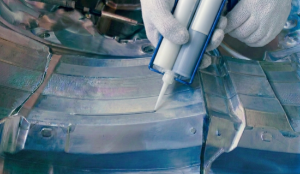
Aerospace Composite Bonding and Surface Preparation
Aerospace composite bonding introduces additional considerations because bond performance depends on both the adhesive and the condition of the surfaces being joined.
Composite structures may involve carbon fiber-reinforced materials, honeycomb cores, bonded skins, or assemblies combining composite and metallic substrates.
For these applications, surface preparation can significantly influence adhesion and bond consistency. Contamination, moisture, surface condition, and preparation methods can affect the quality of the bonded interface.
The required preparation method depends on the substrate, adhesive system, and repair procedure. Cleaning agents, abrasion methods, primers, and other treatments must be compatible with the specified bonding process.
For aerospace MRO teams, this means evaluating the complete bonding system rather than relying solely on an adhesive's published strength.
Cure Requirements
Cure conditions are another important consideration for aircraft adhesive applications.
Some aerospace adhesives cure at room temperature, while others require elevated temperatures or controlled heating cycles to develop their specified properties.
For MRO operations, the available repair environment can influence how a prescribed bonding process is performed. Factors may include access to the repair area, temperature control, pressure application, available equipment, and the time required to complete the approved cure cycle.
Working time and handling strength are also important, but neither should be confused with full cure or authorization to return an aircraft to service.
A faster-curing adhesive is not automatically an acceptable substitute for a specified material. Any change to the adhesive or cure process must be evaluated against the applicable repair requirements.
Why Qualification and Documentation Matter
 Aircraft repair requirements extend beyond the physical properties listed on a Technical Data Sheet (TDS).
A material may demonstrate suitable laboratory performance while still lacking the qualification or approval required for a particular aircraft application.
Depending on the repair, engineering and quality teams may need to verify:
- Applicable aircraft maintenance or structural repair documentation
- Required adhesive specifications and approved materials
- Manufacturer technical data and cure requirements
- Material shelf life, storage conditions, and lot traceability
- Required inspection, testing, and repair records
The applicable Aircraft Maintenance Manual (AMM), Structural Repair Manual (SRM), Component Maintenance Manual (CMM), or other authorized repair data determines which materials and procedures may be used.
For procurement teams, confirming these requirements before ordering helps ensure the supplied material aligns with the repair documentation and quality process.
Supporting Aerospace MRO Bonding Requirements
Structural and non-structural aircraft bonding applications involve different performance demands, but both require attention to material properties, processing conditions, and applicable specifications.
Understanding how these requirements relate helps engineering, quality, and procurement teams evaluate the materials and technical information needed to support aircraft maintenance.
GracoRoberts supplies aerospace adhesives, composite materials, surface preparation products, and specialty chemicals from leading manufacturers. Through technical product expertise, manufacturer relationships, and value-added supply chain services, GracoRoberts supports aerospace OEM and MRO teams working with demanding material requirements.
Explore our Aerospace Adhesives and Composite Materials offerings to find the materials for your requirements.