
The bondline, the thin adhesive layer between two bonded surfaces, plays a central role in how a bonded assembly performs. Its performance depends on more than the adhesive alone. Surface preparation, mixing, cure, thickness, and service conditions all contribute to the quality of adhesion.
For engineers working with epoxy adhesives, understanding how a bondline behaves, and what the bond itself can reveal, supports better material selection, process control, and troubleshooting. This guide covers adhesive failure modes, the role of glass transition temperature, and how laboratory testing can help confirm adhesive performance.
 What Defines a Strong Bondline?
A well-formed bondline typically has:
- Adhesion at both interfaces: The adhesive bonds effectively to each surface.
- Intended cure: The adhesive layer reached the cure state its specification calls for.
- Consistent thickness: The bondline falls within the range the process allows.
- Continuity: The adhesive layer is free of unintended voids.
Because the bondline is not visible once the surfaces are bonded, the bond itself can offer useful information when questions arise about performance.
Understanding Adhesive Failure Modes
When a bond is tested to its limit, the way it separates provides useful information. Adhesive failure modes are typically described in four categories:
- Cohesive failure: The separation occurs within the adhesive layer, leaving adhesive on both surfaces.
- Adhesive (interfacial) failure: The adhesive separates cleanly from one substrate.
- Substrate failure: The substrate gives way before the adhesive, such as fiber tear in a composite.
- Mixed-mode failure: A combination of the above. The proportions can indicate where the separation began.
Identifying the failure mode is often the first step in understanding how the bondline performed.
Cohesive vs. Adhesive Failure: What Each Indicates
The word “adhesive” describes both the material and one failure mode, so the two are easy to confuse. Distinguishing cohesive vs. adhesive failure helps point engineers toward the factors most worth reviewing.
Adhesive failure draws attention to the interface. Surface preparation, cleanliness, time between preparation and bonding, and compatibility with the substrate or primer are the areas to review first.
Cohesive failure generally indicates that adhesion at the interface held and the adhesive layer determined the result. When it occurs at the expected strength, it suggests the bond reached its design capacity. When it occurs at a lower value, mix ratio, cure, voids, and bondline thickness may warrant review.
Required failure modes and acceptance criteria are defined by your process specification.
Factors That Influence Bondline Performance
Several variables shape how well a bondline performs. Depending on the application, these may include:
- Surface preparation: Cleanliness, surface condition, and the time between preparation and bonding can influence adhesion.
- Mixing and mix ratio: Accurate ratio and thorough mixing help the adhesive reach its intended properties. Air introduced during mixing may leave voids.
- Cure conditions: Temperature, time, and heat distribution affect how fully the adhesive cures.
- Bondline thickness: Thickness that is too low or uneven may change how the adhesive carries load.
- Service temperature: Operating temperature relative to the adhesive’s glass transition temperature influences stiffness and strength.
- Moisture and environment: Exposure conditions can affect adhesion at the interface and the cured adhesive itself.
Glass Transition Temperature and Bondline Performance
Glass transition temperature (Tg) is the temperature range over which a cured epoxy shifts from a rigid, glassy state to a softer, rubbery one. Above this range, stiffness typically decreases and the adhesive may lose strength. For bonded assemblies exposed to heat, Tg is one of the most important properties to understand.
Tg also provides useful information in two ways:
- It reflects cure state: Tg depends on how fully the adhesive cured. An under-cured epoxy typically shows a lower Tg than a fully cured one, so measuring Tg on a cured sample can help confirm that the intended cure was achieved.
- It defines the operating margin: Comparing the adhesive’s Tg to the expected service temperature helps engineers confirm the bond will operate within its intended range.
Tg is commonly measured by differential scanning calorimetry (DSC) or dynamic mechanical analysis (DMA). The two methods can report different values for the same material, so results are best compared using the same method and test conditions.
Controlling Bondline Thickness
Thickness is one of the more controllable variables in a bond. Fixturing, clamping pressure, and adhesive flow during cure all influence the final result.
One common approach is to include spacer particles, such as glass beads, in the adhesive to help maintain a minimum bondline thickness. Resin Formulators RF 2070 is a toughened paste adhesive formulated with glass beads for bond line control.
Epoxy Test Methods That Support Bond Evaluation
An epoxy test on the adhesive itself can help confirm that the material performs as expected. Relevant methods include:
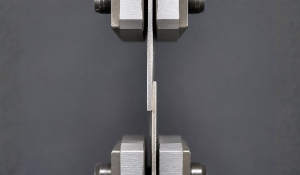
- Lap shear (ASTM D1002): Two metal coupons are bonded with a half-inch overlap and pulled in tension, creating shear in the bondline. The result is reported as lap shear strength.
- T-peel strength: Measures the relative peel resistance of adhesive bonds between flexible adherends.
- Degree of cure, DSC, and Tg: Show how fully the adhesive cured and where it transitions.
- Mixed viscosity, gel time, and pot life: Confirm the adhesive’s working properties after mixing.
- Water absorption: Evaluates moisture uptake relevant to long-term durability.
- Coefficient of thermal expansion (CTE): Shows how the material responds to temperature change.
These tests characterize the adhesive system on prepared test specimens. They complement, rather than replace, inspection of production bonds, and they do not qualify a material to an OEM or aerospace specification. Requirements for your application are set by your process specification.
Advanced Lab Testing from Resin Formulators
Resin Formulators’ laboratory in Carson, CA provides advanced lab testing with an on-site chemist and lab technicians. Testing can be performed on Resin Formulators epoxy resins or on specialty chemicals from other manufacturers, so an adhesive can be evaluated regardless of where it was purchased.
For teams reviewing bondline performance, lap shear, degree of cure, and Tg testing on the adhesive can help confirm that the material performs as intended, which makes it easier to focus on surface preparation, mixing, cure, or design. Our chemist can also help interpret results and discuss next steps.
Click here to explore Resin Formulators' Advanced Material Lab Testing Services.
Supporting Bondline Performance Through Custom Formulation and Packaging
Some bondline variables can be built into the material and its packaging. Resin Formulators offers custom formulation, including modifications to existing products, and does not charge for R&D hours during custom formulation development. Specialty packaging options include premixing, freezing, and degassing, along with side-by-side cartridges and syringes. Packaging like this can help support accurate mix ratios and reduce air entrapment at the point of use.
Featured Epoxy Solutions
- RF 2070 A/B: A toughened paste adhesive with high peel strength at room temperature and lap shear strength retention to 225°F (107°C). Glass beads are included for bond line control.
- RF 6110 A/B: A two-part, volume-dispensing structural adhesive with high peel strength and elevated temperature performance. It cures at room temperature, with elevated cure available.
- RF 6100 A/B Kit: A medium viscosity, high temperature epoxy adhesive system for bonding metal and composite structures.
Support Bond Performance with Resin Formulators
Resin Formulators, the custom formulation division of GracoRoberts, combines epoxy adhesives, custom formulation, specialty packaging, and in-house lab testing to support strong, consistent bonds.
Shop Resin Formulators adhesives online, or talk to a formulation engineer or chemist about your application.